
 “Why this farce, day after day?” The influential Ontario Tobacco Research Unit (OTRU) is seeking to convince Ottawa to eliminate all nicotine use in Canada by 2035. The likely result of such a draconian policy brings to mind Samuel Beckett’s bleak 1957 play Endgame. At right, a production of Endgame at PICT Classic Theatre in Pittsburgh, Pennsylvania. (Source of photo: Entertainment Central Pittsburgh)
If Ottawa chooses to follow the OTRU’s advice, the result will be worse outcomes across a wide range of measures, including lifespans, criminal activity and social inequities. If Canada really wants to help smokers live healthier and more productive lives, we need a very different endgame.
Anti-Tobacco MVP
The OTRU is a tobacco research group in the University of Toronto’s Dalla Lana School of Public Health. It was founded in 1993 with provincial funding and proved influential in the push to ban indoor smoking in the early 2000s. It also played a central role at the pivotal Tobacco Endgame Summit at Queen’s University in 2016 that set the goal of stopping tobacco use in Canada by 2035; Robert Schwartz, the OTRU’s current executive director, co-chaired that event. As the OTRU’s own website boasts, “Over two and a half decades, we have become a key player in the tobacco control community in Canada and internationally.” Its new report, Canada’s Tobacco Endgame: A Critical Evaluation at the Midpoint of the Path to 2035, released late last year, builds on this reputation by offering the group’s observations and advice to Ottawa on how to put its endgame into practice.
The federal Liberals’ current anti-smoking policy – largely based on the 2016 Summit’s recommendations – was unveiled in 2018 as Canada’s Tobacco Strategy. It boasts a $66 million per year budget and seeks to reduce the share of Canadians who use tobacco from the current rate of around 11 percent to below 5 percent by 2035. Known by the catchphrase “Less Than 5 By 35”, campaigners often refer to this policy as a “zero tolerance” goal. As it’s unrealistic to expect the complete cessation of smoking nationwide, anything less than 5 percent is generally considered functionally equivalent to zero.

Lately, however, Ottawa’s path to zero seems to have stalled due to a lack of fresh thinking. In 2023, for example, the Justin Trudeau government declared a “world’s first” in tobacco control when it required tiny health warnings on every cigarette sold. This was presumably based on the belief that some smokers are still not aware of the risks smoking entails – despite printed warnings on every carton and pack of cigarettes sold legally in the country as well as literally decades of public service announcements, media reports, medical scoldings, municipal bylaws and even TV show warnings that declare, “This program contains depictions of smoking.”
A year later, Ottawa introduced additional regulations to restrict the sale and marketing of oral nicotine pouches – an alternative to cigarettes and a useful aid in quitting smoking – by requiring they be sold only in pharmacies. The government thus made it harder to buy a product meant to help smokers ditch the dirty habit than to buy a standard cancer dart. While Ottawa recently signalled it may relax its nicotine pouch rules, the current policy path reveals a troubling lack of vitality and imagination.
The OTRU’s endgame report offers a roadmap for the rest of the way to 2035. Unfortunately, it’s a map to nowhere. The real risk is that Ottawa will heed its advice.
Pick Your Poison
Any discussion of a tobacco endgame must confront the nature and scope of products to be included. Should a zero-tolerance target apply solely to combustible cigarettes and cigars? Or should it also include the wide variety of smoking alternatives, including chewing tobacco, electronic cigarettes, nicotine pouches and heated tobacco products? This is a crucial distinction because the appearance of new alternatives has altered the parameters of public health policy.
Briefly, these new products are much less risky than cigarettes. Research from the Royal College of Physicians, the Cochrane health information collaboration and Public Health England reveals clearly and unambiguously that e-cigarettes (or vapes) involve a small fraction of the overall health risk associated with traditional smokes. “E-cigarettes around 95% less harmful than tobacco estimates landmark review,” reads the headline for a press release touting Public Health England’s pronouncement on the issue back in 2015.
The reason is simple. Regular cigarettes burn tobacco, releasing not only the nicotine that smokers crave but also a cloud of cancer-causing toxins. E-cigarettes dispense a lower-risk vaporized nicotine liquid. Heated tobacco products are slightly riskier than vapes, but since they also avoid combustion, they’re also much less toxic than cigarettes. Oral pouches are even less risky, entailing perhaps one-hundredth the risk of combustibles. To be clear, all these products deliver nicotine to users – and nicotine is addictive. But it is not a substantial health risk.
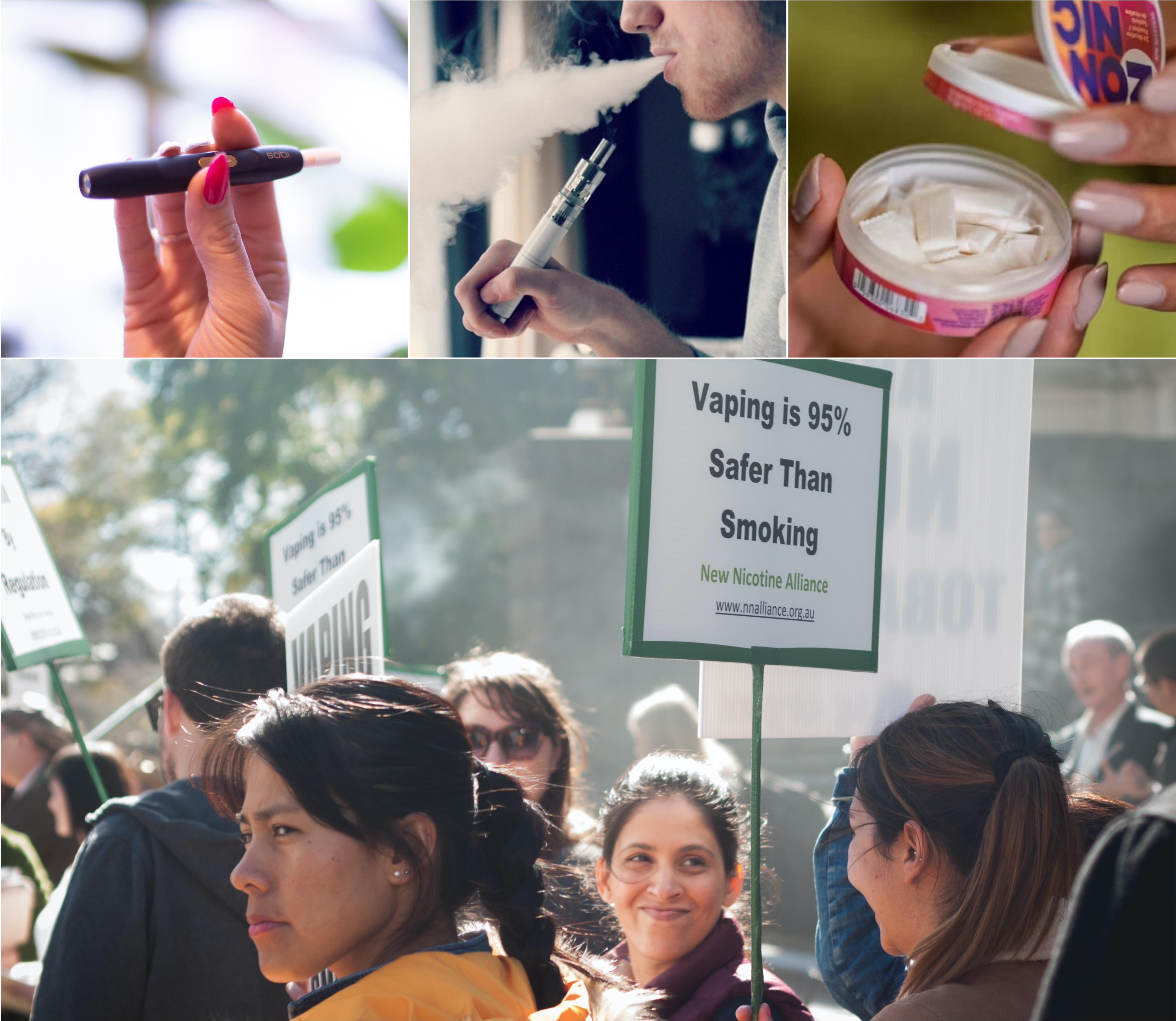
Beyond lowering health risks, all these products offer an “off-ramp” for smokers who wish to quit gradually. The evidence referenced above firmly establishes that e-cigarettes help people stop smoking. Advocates of tobacco harm-reduction policies, myself included, see such substitution as a desirable solution to a killer addiction and thus worthy of promotion. [Editor’s note: tobacco harm reduction should be considered distinct from illegal drug harm-reduction policies.]
Prohibitionists like the OTRU, however, lump all nicotine products into the same bin and want alternative products subjected to the same end target of essentially zero usage. Again, this runs contrary to the best available science as well as the overarching purpose of a coherent public health policy. A goal of zero cigarette smoking is one that all health advocates should adopt. It is not realistic, however, to support zero nicotine use because it denies individuals the right to consume lower-risk products and effectively throws away a valuable option for individuals who wish to quit smoking slowly over time.
Celebrate the Wins
The OTRU’s report usefully covers the many ways in which all levels of government have reduced tobacco use in Canada since the 1990s. Federal and provincial policies have built a culture of smoking denormalization through taxes, bans, advertising limits, health messaging and other measures. Smoking rates for Canadians over the age of 15 have fallen sharply from 25 percent to the current 11 percent. Youth and young-adult smoking is at an all-time low. A mere 1 percent of teenagers are daily smokers today, compared to over 20 percent three decades ago. While premature deaths from tobacco are estimated at around 40,000 currently, this number largely reflects past smoking levels. A future health dividend awaits as the effects of the past three decades’ reduction work their way through the population.

But the OTRU misleads readers about the reasons for this happy turn of events, implying that the observed decline in cigarette smoking occurred independently of the appearance of new alternative products. Major vaping brands Juul and Vuse entered the market in 2018 following Ottawa’s legalization of e-cigarettes. By the early 2020s, the vaping rate, according to the Canadian Tobacco and Nicotine Survey, was around 6 percent, with most vapers having switched over from cigarettes. This is a good-news story – yet it is never properly recognized in the OTRU’s report, which does not even mention Juul or Vuse.
The authors also ignore a significant quandary: that it’s now harder for smokers to buy lower-risk cigarette replacements than regular, death-dealing smokes. As mentioned earlier, in 2024 then-federal health minister Mark Holland declared that approved oral nicotine pouch products such as Zonnic could only be purchased from pharmacists, who were required to keep them behind the counter. Holland added other limitations on advertising and restricted the available flavour choices to mint or menthol. In doing so, he admittedly resisted the even-more aggressive demands of anti-smoking lobby groups who wanted the pouches to be completely flavourless.
Despite Holland’s small concession on flavours, his policy makes no practical, medical sense. This point was raised earlier this year by Alberta Premier Danielle Smith when she wrote to current federal health minister Marjorie Michel asking her to reconsider Holland’s restrictions. “Restricting access to nicotine pouches creates barriers for adults who are actively trying to reduce or quit their nicotine consumption,” Smith stated. “When a regulated alternative is more difficult to access than cigarettes, it sends the wrong signal and complicates efforts by adults working to lessen their dependence.”
Encouragingly, earlier this month a federal source told the National Post that pressure from Smith and other premiers, as well as convenience store owners, has prompted “interest on our end” to loosen the limitations on Zonnic sales. The same source cautioned, however, that no decision has been reached and the tobacco file is not a priority in Ottawa. Until further notice, the nonsensical status quo will remain.

While lacking in practical sense, the current federal policy strongly reflects the OTRU’s puritanical outlook. As its report states, “An effective endgame strategy must therefore maintain surveillance and regulatory oversight of the entire spectrum of tobacco products to prevent substitution and ensure that progress is comprehensive.” A defining trait of prohibitionists is that they write excessively in the imperative mood. The OTRU offers no mercy to those addicted to nicotine or who might wish to consume nicotine because of its potential utilitarian benefits. But why would any rational policymaker think they “must…prevent substitution” towards better health outcomes?
Big, Bold – and Mean
The OTRU’s dogmatic stance is even more puzzling given the fixation on “social equity” that has come to define progressive politics in the 21st century and runs through its own report. The OTRU’s review properly recognizes that smoking rates are much higher than average for many groups frequently defined as disadvantaged. The mentally ill, gays, lesbians and transgenders, Indigenous people, inmates and the homeless all smoke at rates far above the national average – and will suffer the most from misguided tobacco policies.
And despite the important role public information campaigns have played in the past in reducing smoking rates, the OTRU seems wholly uninterested in correcting any current misconceptions. The 2022 Canadian Tobacco and Nicotine Survey, for example, revealed that a mere 5 percent of the population properly understands that vaping is much less harmful than smoking. Rather than advocating greater awareness of this important fact, the OTRU’s report seems to prefer public ignorance. There is little role for individual agency in such a Calvinist worldview, nor genuine compassion for those addicted to nicotine.

The Endgame report is equally silent on the benefits of nicotine. In a recent “The Best Laid Plans” Substack post, journalist Marc Gunther provides a useful summary of the many significant, if little-known, advantages nicotine can provide – from greater alertness and cognitive function to a pleasurable calmness. Gunther quotes Neal Benowitz, professor emeritus of medicine at the University of California San Francisco, on the topic. “Alcohol and cannabis, in my perspective, are much more harmful than nicotine,” Benowitz states, adding that, “If you look at people with attention deficit problems, like ADHD, or some forms of depression or mild forms of dementia, nicotine enhances cognitive function.” Again, nicotine is not carcinogenic.
The Black Market for Smokes
In addition to mis-specifying the problem of tobacco use and its potential solutions, the OTRU’s roadmap pays shockingly short shrift to the role of the illegal market. Black-market smokes have been a subject of considerable interest in recent years. A 2023 report for the Convenience Industry Council of Canada covering B.C., Ontario and Newfoundland and Labrador put the overall share of illegal cigarettes at approximately one-third of the national total. Queen’s University researcher Christian Leuprecht has found that the illegal provision of newer nicotine products such as vapes and e-cigarettes is equally massive.
My own research into the grey and black markets shows nicotine users have found many ways to circumvent restrictive policies. Quebecers consume twice as much e-liquid as is sold legally in the province; in Nova Scotia, it’s three times. This is primarily the result of online purchases. And it can be assumed that many of these purchasers are seeking out flavours and formats banned by prohibitionist-minded governments.
Clamping down on legal markets for cigarettes and their alternatives will not make this problem go away; it will worsen it in many ways. Not only will usage continue, but legal businesses will find themselves unable to compete with black marketeers, governments will be denied excise duties and nicotine users will be left at the mercy of unregulated and potentially unsafe products.

Additionally, we must recognize the longstanding relationship between illegal tobacco and Indigenous peoples. Research has clearly established that the bulk of illegal cigarette production occurs on native reserves, much of it by criminal gangs. Some of the retailing of illegal cigarettes and non-combustible nicotine products also happens at smoke shacks on Indigenous land. More restrictive policies on non-combustibles in the rest of Canada meant to achieve “zero-everything” will likely increase this conversion of legal business trade into illegal operations on reserves. Greater criminality will not aid an “equity-focused endgame.”
Curiously enough, OTRU executive director Schwartz is the co-author of a lengthy 2025 paper that delves deeply into the tobacco black market in Ontario and Quebec. The potential for unintended consequences is clearly not an unknown for the OTRU report’s creators.
New Zealand: An “Exceptional” Vaping Strategy
“To reinvigorate its own strategy, Canada can draw valuable lessons from the bold and innovative endgame models being pursued by other nations,” the OTRU report states with its typical flourish. In keeping with the rest of its argumentation, however, the international examples it presents are often misrepresented or are themselves deceptive or unscientific.
Consider the praise – “bold measures”! – heaped on New Zealand’s 2022 anti-smoking legislation introduced by former Prime Minister Jacinda Ardern’s Labour government that sought to bar residents born after 2008 from ever legally buying cigarettes. Despite the laudatory comments, the proposal never came into effect. It was rescinded by the subsequent conservative coalition government in 2024, largely due to concerns about its effect on the black market.
New Zealand’s new leaders were well aware of the violence associated with illegal tobacco sales in Australia, where more than 200 tobacco shops and other buildings have been firebombed by gangs fighting for control of black-market tobacco sales. In 2024 half of Australia’s national cigarette market was illegal, as was 95 percent of the vaping market – with most of this criminal activity a response to prohibitionist-minded policies. New Zealand had good reason to repeal its impending duplication of that disaster.
 A strategy that works: Evidence from New Zealand reveals that efforts to convince smokers to switch to vaping have reduced cigarette use among the Maori population from 37 percent in 2011 to just 15 percent in 2024. (Source of graph: New Zealand Health Survey, 2011-2025, modified by C2C)
New Zealand offers another important lesson the OTRU’s authors studiously ignored. Similar to Canada, the country’s indigenous Maori people smoke far more than other New Zealanders. Yet as the accompanying graph shows, their smoking rate has fallen significantly – from 37 percent in 2011 to 15 percent by 2024 – mainly due to switching to vaping.
New Zealand’s conservative coalition has adopted an explicitly pro-vaping policy known as Vape To Quit Strong. Last year, national health minister Casey Costello announced a plan to distribute 7,290 vaping devices and 67,750 pods in hopes of convincing smokers to switch, with Maori users a major focus. It’s working.

Robert Beaglehole is the former director of New Zealand’s Action for Smokefree 2025, a lobby group that originally sought to end smoking in the country by 2025. While that target was missed, Beaglehole is willing to recognize some big accomplishments along the way. “Before 2018, we were way off course for the 2025 target; it was unlikely to be achieved until after 2040 – and beyond 2060 for Māori,” he wrote in the New Zealand Herald last year. “But a pragmatic shift to cheaper and less risky vapes has changed the trajectory…The drop has been steepest for Māori, with the rates halving in six years. This progress is exceptional.”
Yet like the OTRU, many other New Zealand anti-smoking groups continue to insist that all nicotine use is bad and must end. “Despite this extraordinary progress,” Beaglehole laments, “the narrative is framed as failure.”
Generational Bans and the Snus Revolution
Unlike New Zealand, the UK remains intent on imposing a generational ban on smoking. In January 2027 it will become illegal for anyone born in 2009 or later to purchase cigarettes. Naturally, the OTRU applauds this move, calling it “decisive action”. But its report again overlooks several important underlying factors. As the accompanying graph shows, cigarette use is already falling in the UK. Meanwhile, total nicotine use among those under 44 is rising rapidly; among young adults and youth, it is already around 35 percent. The new legislation may push that even higher. Such an outcome is utterly incongruous with what Endgame proposes for Canada, given that the OTRU demands a nicotine use rate for all ages of less than 5 percent.
Such a gap in logic seems irreconcilable.
 Smoking down, nicotine up: The UK’s pro-vaping policy has helped lower smoking rates, particularly among younger Britons. At bottom, an ad for the UK National Health Service’s Quit Smoking app. (Sources: (chart) 10.1111/add.70243, modified by C2C; (image) @NHSEnglandLDN/X)
Sweden is another country the OTRU praises. “The prevalence of people 16-84 who smoke daily is 6.4% which means Sweden is approaching their Endgame goal,” the report states. “Among European countries, Sweden has the lowest rate of tobacco-related disease and death.” What the OTRU fails to mention is that this decline has been driven by the widespread adoption of snus (moistened tobacco placed under the upper lip) and oral pouches. Like the UK, Sweden has high rates of nicotine use: over 20 percent. Based on current data, it is inconceivable that Sweden could ever sink below the 5 percent rate the OTRU wants for Canada.
The same holds for Norway. The smoking rate in that country has also declined while the rate of smokeless use has climbed – with total nicotine product uptake around 25 to 30 percent. Evidence from other Nordic and Baltic countries similarly indicates high use of oral pouches, snus and e-cigarettes among youth and young adults. How can any of these countries be a model for the OTRU when they’ve all adopted tobacco harm-reduction strategies completely opposed to the advice the group is offering Ottawa?

Smoking and Drinking and Carrying On
The OTRU’s impractical, fact-blind and overly rigid recommendations for the federal government share certain tendencies with researchers and lobby groups engaged in other “sin product” policy reports – most notably anti-drinking research.
Case in point: in 2023 the federally funded Canadian Centre on Substance Use and Addiction (CCSA) released its proposed new Guidance on Alcohol and Health. This widely publicized report purported to update the federal government’s existing Low-Risk Alcohol Drinking Guidelines. Existing federal recommendations, adopted in 2011, state it is safe to drink 14 standard drinks per week for men, and 10 for women. This level was arrived at by balancing the recognized health risks and benefits of alcohol use, and is based on ample scientific evidence. It has the added benefit of being entirely reasonable; according to Statistics Canada, 85 percent of Canadian adults already abide by these limits.
 Déjà vu: The OTRU’s puritanical crusade against nicotine brings to mind the Canadian Centre for Substance Use and Addiction’s 2023 campaign that sought to replace federal drinking guidelines with a zero-tolerance position. That effort failed; the OTRU’s Tobacco Endgame report deserves a similar fate. (Source of photo (enhanced): jewdini, licensed under CC BY 2.0)